
Technical Analysis - Part 7: Demystifying 5 Essential Types Of Trading Charts In Technical Analysis
The BEST market insights, strategies and guides to trading and investing
Hey STARS 🌟
Welcome to an exciting new blog series: Technical Analysis! In this multi-part series we'll delve deeper into various aspects of technical analysis exploring different strategies and how it can enhance your investment decisions.
Let's dive in.
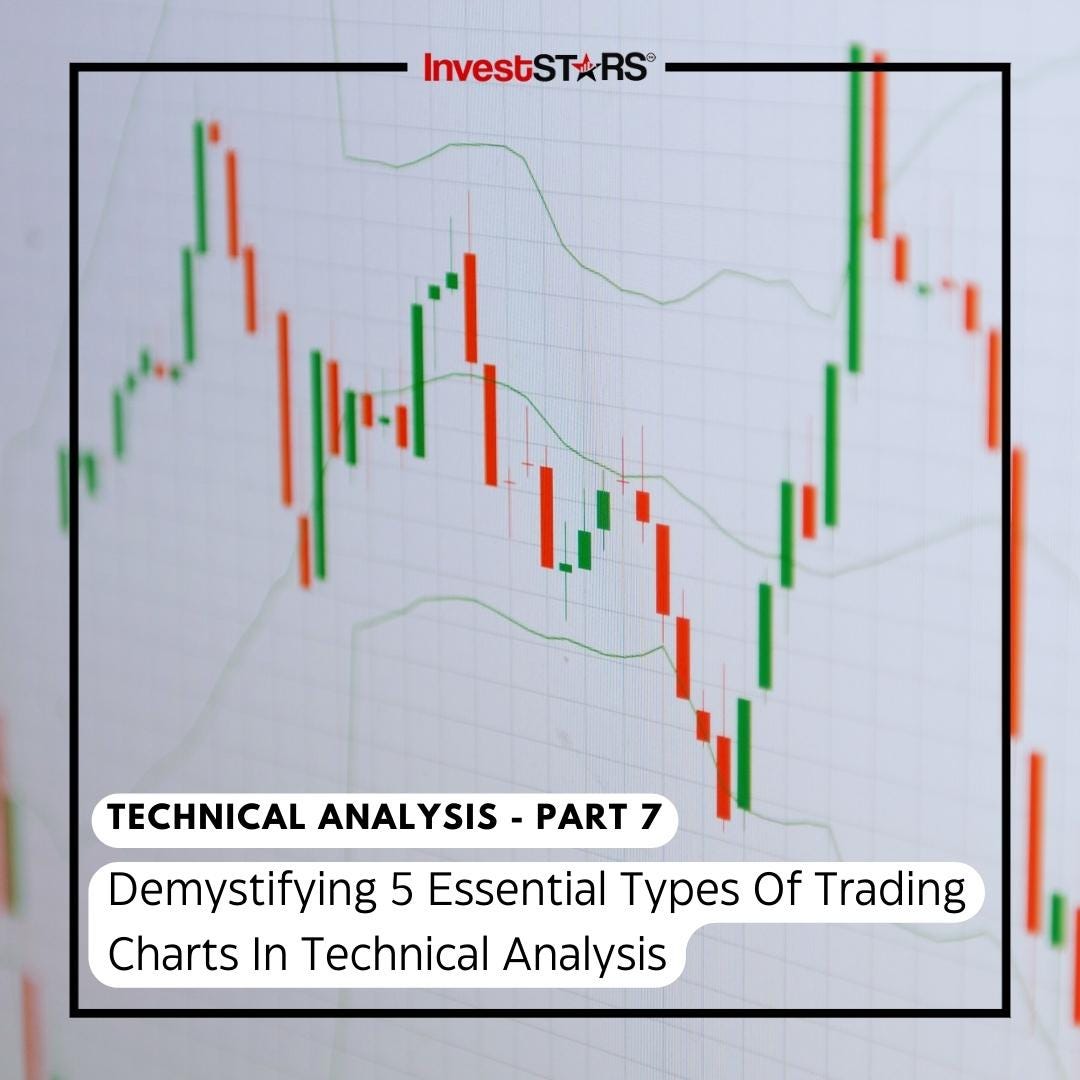

📊 Technical Analysis - Types of charts
What other investing topics would you like to learn more about? Comment below and let me know!
There are various approaches to conducting technical analysis, and one way is to use a candlestick price chart that displays the price history and buying/selling patterns within a specific timeframe. Some investors also utilize technical indicators in conjunction with price charts or employ specialized techniques such as Elliott wave theory or harmonics to identify potential trades. Some investors combine different methods, but it's important to avoid information overload that can hinder one's ability to interpret the chart effectively. However it's important to note that it there is no foolproof strategy and that market behavior can be unpredictable.
Some investors prefer to establish specific rules that must consistently apply before entering trades to enhance the objectivity of their trading decisions which may help to eliminate emotional biases. However it's important to note that it there is no foolproof strategy and that market behavior can be unpredictable.

👉 Candlestick Charts
Candlestick charts are sometimes used chart type in day trading. These charts provide a clear visualization of the price movements and the supply and demand dynamics in the market. Candlesticks are formed by plotting the opening, high, low, and closing prices of an asset for a specific time period. The candlestick chart displays the price action in a series of candlesticks, with each candlestick representing the open, high, low, and close for a specific period. The color of the candlestick can sometimes indicate whether the price goes up or down during that period.
Candlestick charts are sometimes used in modern software and depict bullish candles in green or white, which may represent situations where the current price is higher than the opening price. Conversely, bearish candles are commonly shown in red or black, indicating situations where the current price is below the opening price. These charts display the difference between the opening and closing prices through the body of the candle, as well as the total daily range from the top of the wick to the bottom of the wick.
👉 Open-High Low-Close (OHLC) Charts
OHLC charts, also known as bar charts, display the same information as candlestick charts but in a different visual format. OHLC charts use vertical bars to represent the price range for each time period. OHLC charts can sometimes be useful for traders who prefer a more simplified view of price action and do not need the additional information provided by candlestick charts.
👉 Line Charts
Line charts are the simplest type of chart and sometimes used in day trading. They only show the closing price for each period and connect the dots to form a line. This chart type can sometimes be useful for identifying long-term trends but may not provide enough information for day traders looking for short-term trading opportunities.
👉 Area Charts
Area charts are similar to line charts but show the area under the line as filled in. This chart may be useful for comparing the relative strength of different assets but may not provide enough information for precise day trading.
👉 Heiken-Ashi Charts
Heiken-Ashi charts use a different formula to calculate the open, high, low, and closing prices for each period. Prices are smoothed to better indicate trending price action, and noise is removed from the chart. Heiken-Ashi charts may be useful for traders who want to reduce market noise and focus on the overall trend of the asset.
It's important that you conduct your own independent research and all investors should educate themselves to be able to better understand these different methods.
References:
(1) Technical Analysis: The Complete Resource for Financial Market Technicians" by Charles D. Kirkpatrick II and Julie R. Dahlquist (2016)
(2) Getting Started in Technical Analysis" by Jack D. Schwager (1999)
(3) Japanese Candlestick Charting Techniques: A Contemporary Guide to the Ancient Investment Techniques of the Far East" by Steve Nison (1991)
(4) Technical Analysis Explained: The Successful Investor's Guide to Spotting Investment Trends and Turning Points" by Martin J. Pring (2014)
Disclaimer: Please be aware that I do not provide investment advice on behalf of myself or any other legal entity and clients are meant to make their own independent decisions. All content is for informational purposes.
What do YOU think?
Investment platforms:
Best for: Community vibes

Best for: Trading Cryptocurrency

Best for: Copy Trading

Tools:
Best for: Charting

We hope that these tools and platforms are useful. If you’d like to subscribe to our newsletter - feel free. We’d love to have you on board. Remember, it will ALWAYS be free.

Disclaimer: Please be aware that I do not provide investment advice on behalf of myself or any other legal entity and clients are meant to make their own independent decisions. All content is for informational purposes.